Dig Out Crawl Space For Basement
Basement dig out vs. A new addition. If you live in an area where property taxes are high, or your lot will violate zoning code by adding an addition, a basement dig out will make sense. Say you have a 2 story 2000 sf home and you need 1000 sf of extra living space. An addition will cost more than a basement dig out.
We get asked all the time if we convert crawl spaces into basements and the short answer is no; Here's why.
First of all, the cost to convert a crawl space into a full and functioning basement is extremely high. The existing crawl space needs to be dug out, a new foundation poured and finishing on top of that. We are talking dollar signs.
We can take a closer look at the issues with adding on a basement and why that investment may not be worth it. Pouring a new foundation addition on a home is rather tricky. To gain access to pour the foundation the home would need to be supported on stilts while the new concrete is poured. This step is extremely important to make sure the seams are mended between the two seperate foundations so as to not allow leaks. Keep in mind basements are already suceptible to ground water intrustion.
Not only will this project cost you a lot of money but it will cost you a lot of time too. It is an extensive project with many steps that all need to be done correctly. With any type of extensive construction job, there is the risk of uncovering hidden issues that will delay the completion of the job and cause further interuption in your home and daily life.
We suggest taking a look at your motivation for converting your crawl space. If it is just extra storage space you are looking for, then installing a warranted 20mil vapor barrier is the perfect solution. Our CrawlSeal liner is sealed to the foundation walls to keep out moisture, dust and critters and provides the perfect place to store boxes, furniture, and all that unnecessary clutter, freeing up space in the rest of your home! Not only is CrawlSeal durable, warranted, and clean looking, but it is much more cost effective and installed in a day or less!
Digging out a basement can add quality living space to your home

By Ian Harvey, Toronto Star
Basement excavation and underpinnings aren’t for the feint of heart. As renovations go, it’s one of the most technically complex construction techniques to execute because, done wrong, it can literally bring the house down. Also, the homeowner is liable for damage caused to neighbour’s homes as well, so it’s wise to do it right and ensure insurance coverage and hire a qualified, experienced contractor.
Turning that dingy, damp stone-age space into a quality living or activity area is fairly easy if there’s full height between the floor and ceiling, of course. The trick is taking homes built before 1950 or so and adding headroom.
Typically, Michael Upshall of Probuilt, a Toronto-based contractor specializing in basement underpinning, sees homes with basements with around six feet of head room with encroachments by ductwork and other mechanicals (plumbing, wiring). Others have even less headroom and are mere crawlspaces.
“The key to successful underpinning of any basement project is planning,” says Upshall, noting there are a few key technical things to keep in mind for those considering an excavation, including making sure the original foundations are good. The important thing is not to stress the existing foundations all at once, says Upshall, and that involves having an engineer determine what condition the footings are in (the base on which the home’s walls are set below ground) and how much weight they are bearing.
Next is to look at the heating and cooling system to see if it should be moved out during the work or whether the contractor should dig around it. In some cases, the furnace or boiler may be due for replacement so everything gets ripped out. The plumbing should also be checked for the same reasons and then the digging can start.
“We dig out the main part of the basement leaving the perimeter,” says Upshall, noting this is where much of the costs start to add up. Digging by hand is expensive because it’s labour intensive.
The best plan is to get a machine down there.
“We can set up a conveyor belt system but sometimes we just dig down outside and cut a hole in the basement wall and come in that way with a Bobcat (small front end loader), ” says Upshall, who says budgeting $30 to $40 a square foot (for just the excavation) is a good starting point.
Next, the perimeter floor is marked out in two- or three-foot sections.
“Each section is numbered – one, two, three and sometimes four, whatever the engineer directs,” he says. “Then we cut out each section numbered “one” all the way around leaving the spaces between untouched.”
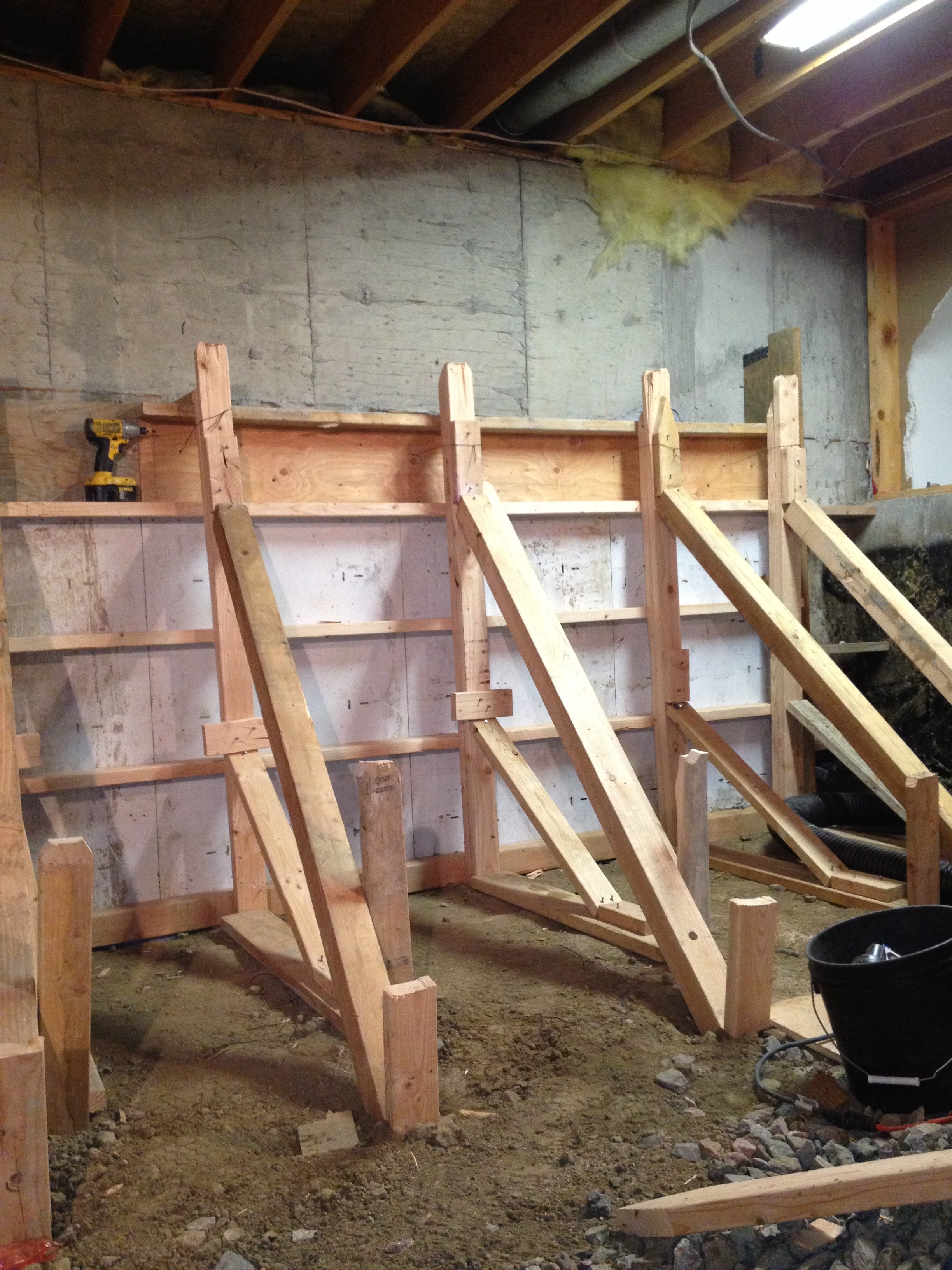
This way, there are still two or three other sections holding up the walls and the crews can dig down to the required level, set in a concrete form and pour new footings.
“We don’t go all the way up to the existing footings, we leave a gap of a few inches,” says Upshall. “Then we come back with a special epoxy grout – it’s $39 a bag – and we hand pack it up to the footing. It also has to be inspected (by the city) at each stage.”
It’s done this way, he explains, because with the amount of dirt in a basement, there’s a risk of contaminating the concrete.
Then, the next numbered section is excavated and the process repeats itself until the entire perimeter is dug out and the footings underpinned.
There are a couple of alternatives to underpinning: one is benching, which involves pouring a mass of concrete away from the wall at the original floor point, about one unit out for each unit down. Therefore, if the basement was to be excavated two feet, there would be a corresponding two-foot by two-foot “bench” intruding into the basement. It’s cheaper and faster and the benches can be hidden by closets or even kitchen-style cabinets.
